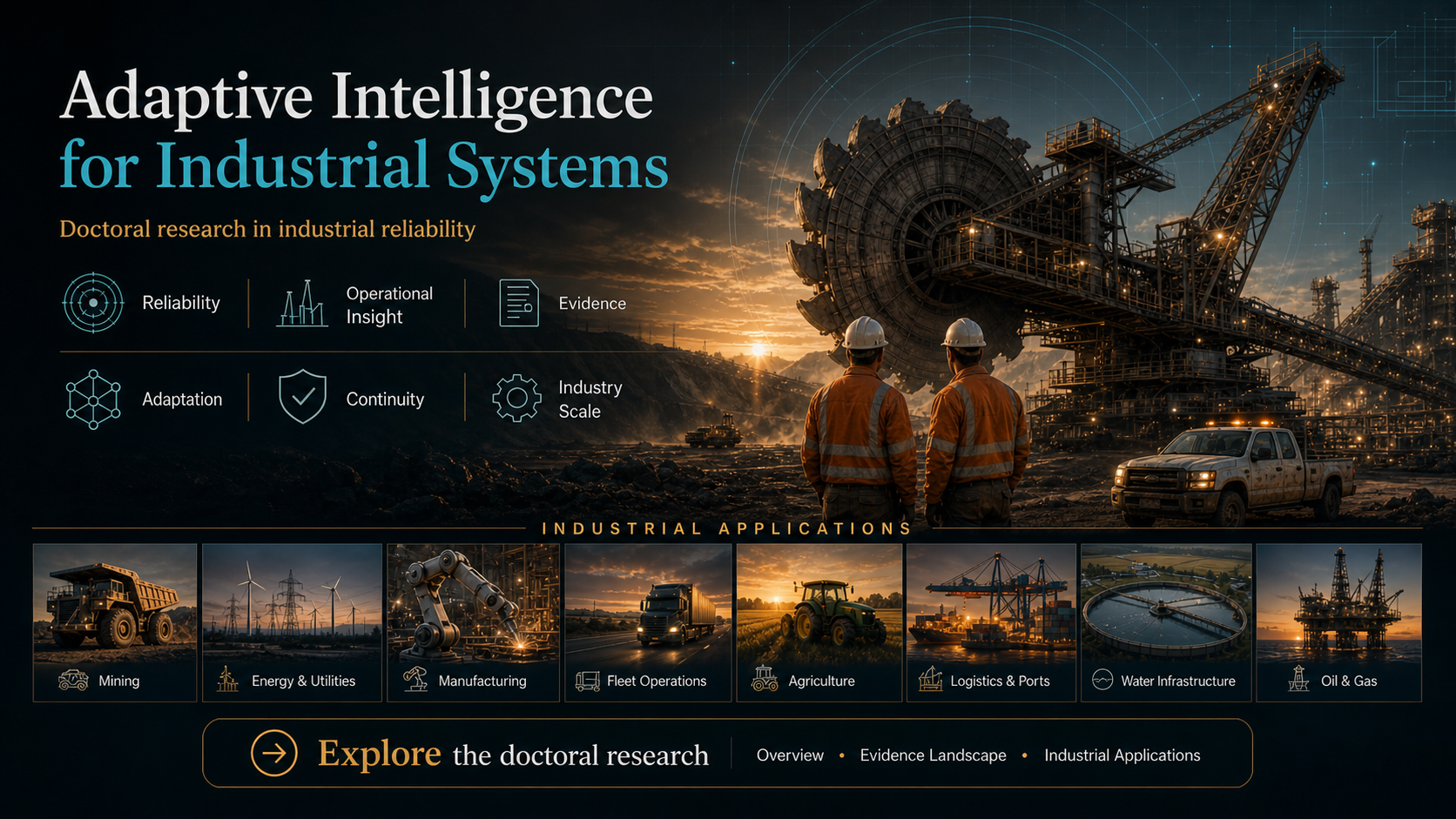
ARC-00 · Entry frame
This opening surface uses the updated thesis poster for the project and establishes the central framing before the evidence, modelling, and immersive sections below.
ARC-01 · Executive research architecture
Adaptive Intelligence for Industrial Systems
This route exposes the research program directly through its architecture, evidence base, semantic maps, alignment checks, and immersive visual layers.
Metrics, figures, and immersive artifacts are visible here through the private asset routes backing `/phd`.
Audit Snapshot
ARC-READ
What the opening surface establishes
The executive board frames the doctoral architecture, shows the scale of the material reviewed, and anchors the transition into the evidence and modelling pipeline.
RQ-H-P
Read the research question, subquestions, hypotheses, contributions, and pillars as one connected architecture rather than as isolated statements.
Scope
The KPIs summarize the proposal structure, semantic blocks, and analytical outputs in one opening board.
Transition
Everything below expands this architecture into the evidence base, lexical surfaces, semantic maps, QA layer, and immersive universes.
Phase 1 · LEX-01
Lexical Surface
The lexical layer exposes the dominant terms, their relative pressure, and their conceptual grouping across the proposal corpus.

LEX-02
Concept Topology
This treemap groups the proposal vocabulary into larger conceptual structures so the topology can be read at a glance.
LEX-READ
What the lexical stage establishes
These first charts surface term pressure, hierarchy, and conceptual grouping across the proposal corpus before the page moves into the evidence base.
Term pressure
The bar chart shows which terms dominate the proposal vocabulary and how strongly each one shapes the overall discourse.
Hierarchy
The treemap groups local expressions into higher-order conceptual blocks, making it easier to read thematic concentration.
Transition
This lexical surface provides the bridge into the evidence base, where the reviewed corpus and validation filters become explicit.
Phase 2 · GEN-01
Evidence Base
This is the point where intake, screening, extraction, and strict-core controls become explicit in the page narrative and visual evidence.
The system distinguishes intake scale, structural readiness, and final trust level so the transition from raw material to validated corpus stays auditable.
Total intake volume admitted into the evidence pipeline before screening and structural validation.
Reviewed records that remain inside the defensible evidence core after initial screening.
Items that passed structural checks and became eligible for downstream machine processing.
Highest-trust subset preserved after manual verification and final quality control.
GEN-02
Intake funnel, filtering, and review-state controls
The intake funnel narrows the evidence base from the initial corpus to the reviewed core, making the screening and exclusion logic visible.
Entry funnel
318 intake items
Intake visualization for the initial corpus considered in the review pipeline.

Screening dataset
302 reviewed-core items
Screening visualization for the reviewed-core subset after exclusions and eligibility checks.

GEN-CTRL · Intake audit
Review-state controls and exclusion gates
This audit layer separates intake volume from trust level so screening decisions, exclusions, and final review thresholds can be read directly.
Silent exclusions are still forbidden. Each drop in the funnel has to remain legible as part of the review and evidence-quality process.
GEN-03
Integrity before modelling
Before any modelling is allowed, the corpus passes a control layer for availability, metadata, extraction, and structural checks.
Integrity dashboard
Metadata and timeline controls
Integrity dashboard covering metadata, coverage, and timeline checks before modelling.

Extraction architecture
318 items processed
Extraction and enrichment architecture applied to the reviewed material.

GEN-04
304 structured, 220 strict-core
Processing success and trust approval remain separate. A document can pass structure checks and still fail the strict-core gate, which is why both thresholds appear independently.
Post-curation audit
304 structured items
Post-curation audit showing the documents that passed structural processing checks.

Strict verification layer
220 strict-core items
Strict-core verification surface for the highest-trust subset used downstream.

GEN-05
Lexical evidence over the validated corpus
Once the corpus survives intake and integrity control, the lexical and conceptual surfaces can be read directly across the validated dataset.
Scientific wordcloud
Lexical center
Lexical image generated from the validated scientific corpus used in the analysis pipeline.

Phase 3 · SEM-01
Semantic Topology
The semantic layer shows geometry, proximity, and cluster shape across the analysed corpus so local neighbourhoods and representative passages can be inspected together.
SEM-READ
What the semantic maps still add beyond the lexical view
The semantic layer measures neighbourhoods, density, and representative passages so the page can move from vocabulary pressure to semantic organization.
Clusters
Points that live close together share semantic territory, which helps reveal the main conceptual neighbourhoods in the corpus.
Representative passages
The secondary map surfaces representative chunks that make each semantic region interpretable instead of leaving it as a purely abstract cluster.
c-TF-IDF
The topic table translates cluster identity into high-signal terms, bridging machine output and human interpretation.
Phase 4 · QA-01
Alignment QA
Similarity measures whether the main dependency blocks align as expected and whether the research structure is internally coherent.
QA-READ
Why this matrix remains the gate
This is the point where persuasive prose has to become a testable structure. The matrix checks whether the problem, hypotheses, contributions, and pillars move in the same direction.
High Alignment
Strong similarity suggests internal coherence: the problem block, hypothesis block, and contribution block are pulling in the same direction.
Low Alignment
Weak similarity is not a visual defect. It signals a structural gap that needs conceptual or argumentative repair.
Gatekeeping
Only after this QA layer does the page move into the blueprint and immersive layer, because synthesis without coherence would aestheticise inconsistency.
Phase 5 · FLOW-01
Dependency Blueprint
The full synthesis stays visible as a dependency graph, from the main research question through the branch structure into P1-P6.
FLOW-READ
How the Sankey resolves the system
This blueprint is the last static synthesis before the immersive layer. It turns the architecture into a directional system of dependencies that can be traced from upstream questions to downstream pillars.
Flow
Read from left to right: the main research question is progressively decomposed into research logic and finally into P1-P6.
Traceability
The point of the Sankey is still traceability. It remains possible to ask whether each pillar code can be traced back to an explicit upstream need.
Handoff
From here the page can move into the source register and immersive modules because the dependency structure is already explicit.
SRC-CTRL
Source Register and Evidence Ledger
Before the immersive layer, the documentary substrate still needs to be explicit. This register ties the research statements, processed corpus, funnel metrics, QA logs, and strict-core verification together.
Source register
Block-level evidence ledger and codebook anchors
These register entries preserve the trace from source material to the analytical outputs shown across the page, including lexical, semantic, QA, and immersive layers.
Source register
SRC-01 · Primary statement ledger
Canonical source for the research statements, question structure, and dependency chain used across the page.
Anchors the original question and dependency text that drives the visual and analytical layers.
Derived corpus
SRC-02 · Enriched language ledger
Language-enriched derivative used to build the lexical and semantic artefacts shown throughout the page.
Bridges raw text and the downstream visual system used in the charts and maps.
Metrics register
SRC-03 · Funnel summary register
Summary register for intake, screening, exclusion, and review-state controls.
Backs the intake, screening, and review counters surfaced in the evidence section.
QA log
SRC-04 · Pipeline health register
Operational quality register for extraction success, recovery paths, and exception handling.
Feeds the QA summaries and integrity views shown across the pipeline section.
Verification log
SRC-05 · Strict-core register
Highest-trust verification register for the final evidence subset used in the downstream analysis.
Anchors the strict-core counters and final evidence quality claims shown on the page.
Final Phase · SIM-01
Immersive Layer
The immersive universe is visible on this route as a direct interactive surface. Orbital structure, proximity, and module relationships remain inspectable inside the original scene.
Every immersive module depends on the upstream chain of custody: intake, extraction auditing, validation, enrichment, modelling, dimensionality reduction, and projection.
SIM-01 · Primary immersive scene
The master immersive interface brings the full orbital scene back into the page as an interactive synthesis of the research architecture.
Preparing immersive scene...
SIM-P
Six micro-universes for granular audit
Each pillar keeps its own orbital scene and remains embedded here for granular inspection.
SQ1 · P1 · Control layer
First micro-universe for the initial control logic block. Tracks the dependency path from the first question block into the first implementation layer.
Preparing immersive scene...
SQ2 · P2 · Signal layer
Second micro-universe for the signal-driven configuration block. Keeps the second dependency block visible as its own inspectable orbital scene.
Preparing immersive scene...
SQ3 · P3 · Adequacy layer
Third micro-universe for the adequacy and comparison block. Represents the third block of the research architecture as its own navigable visual scene.
Preparing immersive scene...
SQ4 · P4 · Safety layer
Fourth micro-universe for the bounded safety block. Preserves the fourth dependency segment as a standalone orbital view.
Preparing immersive scene...
SQ5 · P5 · Memory layer
Fifth micro-universe for the contextual memory block. Keeps the fifth cluster available as a dedicated scene for local inspection.
Preparing immersive scene...
SQ6 · P6 · Coordination layer
Sixth micro-universe for the coordination block. Retains the sixth architecture block as the final inspectable endpoint of the system.
Preparing immersive scene...
Cross-Cutting Value · SQ7
SQ7 remains the cross-cutting value test applied across all six modules. The route keeps that dependency explicit while withholding the original explanatory wording.